Minimal, high-speed arcade tester of reflex and timing
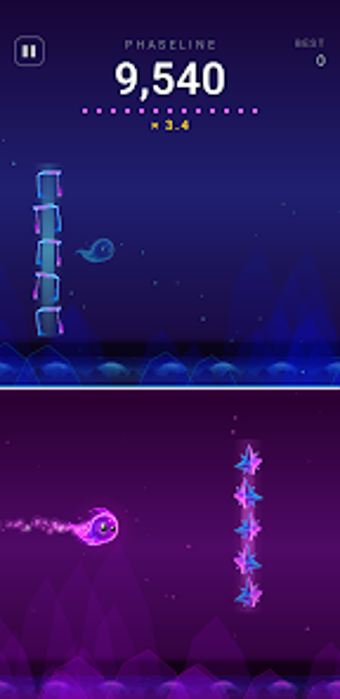
PHASELINE by Tagongo Games is a minimalist arcade title where the player controls a spark that shifts between two parallel realities to survive. The game centers on a single one-tap mechanic to phase between cyan and magenta lanes while avoiding patterned obstacles at increasing speed. Visuals are pared back to cyan, magenta, and a central line of light, and the design targets casual players who enjoy short, reflex-driven sessions and pattern memorization.
What kind of game is PHASELINE?
In this game, the experience is a reflex-based avoidance arcade focused on a repeated core loop: run, observe, and tap. The player rides a spark along a central line and taps to switch realities; cyan and magenta lanes contain distinct obstacles. The stated purpose is fast play, and progression comes from surviving ever-faster sequences rather than from upgrades or story beats.
Does it have modes or deeper mechanics to explore?
In this game, modes are minimal by design: the title emphasizes single-session runs over campaign structure. There is no mention of multiplayer or separate co-op modes, so play centers on solo high-score attempts. The developer enforces pattern-verified obstacle sequences, which ensures sequences are solvable with correct timing rather than relying on random, unwinnable layouts.
What does the game look and sound like?
In this game, the presentation pares back visual clutter to a cyan and magenta palette around a central light line. The minimalist aesthetic prioritizes clarity so obstacles read quickly at high velocity. Audio is functional and supports timing, with responsive feedback on taps; controls are described as one-finger, one-tap, and the app’s roughly 16MB install size keeps load and storage demands low.
Is it hard to get started and does it keep players returning?
In this game, onboarding is implicit: the single-tap control lowers the barrier to entry, while increasing speed creates challenge. The design accepts short learning sessions and rewards pattern recognition. Replay value comes from attempting longer runs and improving timing under faster speeds; there is no narrative progression, so repeated play relies on score improvement and personal mastery.
Clear pick for quick, pattern-focused reflex players
The game is a concise choice for players who enjoy short, high-speed runs and pattern memorization rather than narrative depth. It demands precise timing as speed increases, which suits players who prefer mechanical challenge over exploration. However, those seeking mode variety or social play should expect a purely solo, session-based arcade experience.